At 10 TB per month of internet egress, list-price AWS is roughly $913, Azure $882, Google Cloud $1,137, and Cloudflare R2 zero (EgressCost.com, 2026). Same bytes, same month. That spread is not a rounding error — and it is not the whole bill either, because the charges that actually surprise teams sit on adjacent line items. This piece normalizes what the major providers charge in cloud egress fees, shows the four surcharges that never appear on the egress line, and gives you a test for when flat-rate bandwidth beats per-GB metering.
What the major providers actually charge
Egress pricing is tiered, regional, and quoted differently on every provider's page — which is why side-by-side numbers are rare. The table below normalizes entry rates and the modeled cost of 10 TB of internet egress per month in a standard US region.
Rates verified by EgressCost.com against provider documentation in June–August 2026; AWS regional rates confirmed independently (CloudZero, 2026). Regional variation is significant and often missed — AWS Asia Pacific (Singapore) opens at $0.12/GB and Cape Town at $0.154/GB (CloudZero, 2026), so a us-east-1 estimate applied to an APAC deployment will understate the bill by a third or more.
One mechanic that catches finance teams: AWS volume tiers are cumulative across services within an account and region, not per service. Five terabytes out of EC2 and six out of S3 in the same month land in the same meter. Read per-service cost breakdowns in isolation and you will model the wrong tier.
The four charges that never appear on the egress line
The headline $/GB is the part everyone budgets. These are the parts that show up in the post-mortem.
NAT Gateway processing. AWS charges $0.045/GB for every byte through the gateway, plus roughly $0.045/hour per gateway. Three gateways for multi-AZ redundancy cost about $100/month before processing a single packet, and traffic bound for the internet pays gateway processing and standard egress (LeanOps, 2026).
Cross-AZ traffic. $0.01/GB in each direction, so $0.02 round-trip. A chatty Kubernetes cluster spread across three availability zones generates this constantly. A cluster pushing 10 TB/month of inter-AZ traffic pays roughly $200/month in network fees that never leave AWS (LeanOps, 2026).
Cross-region replication. Roughly $0.02/GB between US regions, billed on the source side. A 10 TB nightly replication to a European hot standby is on the order of $200/day (Bacancy, 2026) — a disaster-recovery decision that quietly became a networking decision.
Public IPv4 addresses. AWS bills $0.005/hour per public IPv4 address, attached or idle — about $3.60/month each (Economize, 2026). Immaterial for one address, a real line item for a fleet of several hundred.
What changed in 2026
On 1 May 2026, Google Cloud raised list prices for CDN Interconnect, Direct Peering, and Carrier Peering, citing infrastructure investment (Google Cloud, 2026). The increase roughly doubled North American peering egress from $0.04 to $0.08 per GiB, with Europe moving $0.05 → $0.08 and Asia $0.06 → $0.085 (SpendArk, 2026).
Standard internet egress did not change, so most workloads pay what they paid in April. The teams affected are the sophisticated ones. CDN Interconnect was the discounted lane that made Google Cloud Storage viable as a CDN origin, and it applies automatically to traffic destined for allowlisted CDN IP ranges — no configuration, no opt-in, no opt-out. If your origin sits in GCS and you serve through Cloudflare, Akamai, or Fastly, your origin-to-edge egress rate changed on 1 May and nothing in your Terraform did.
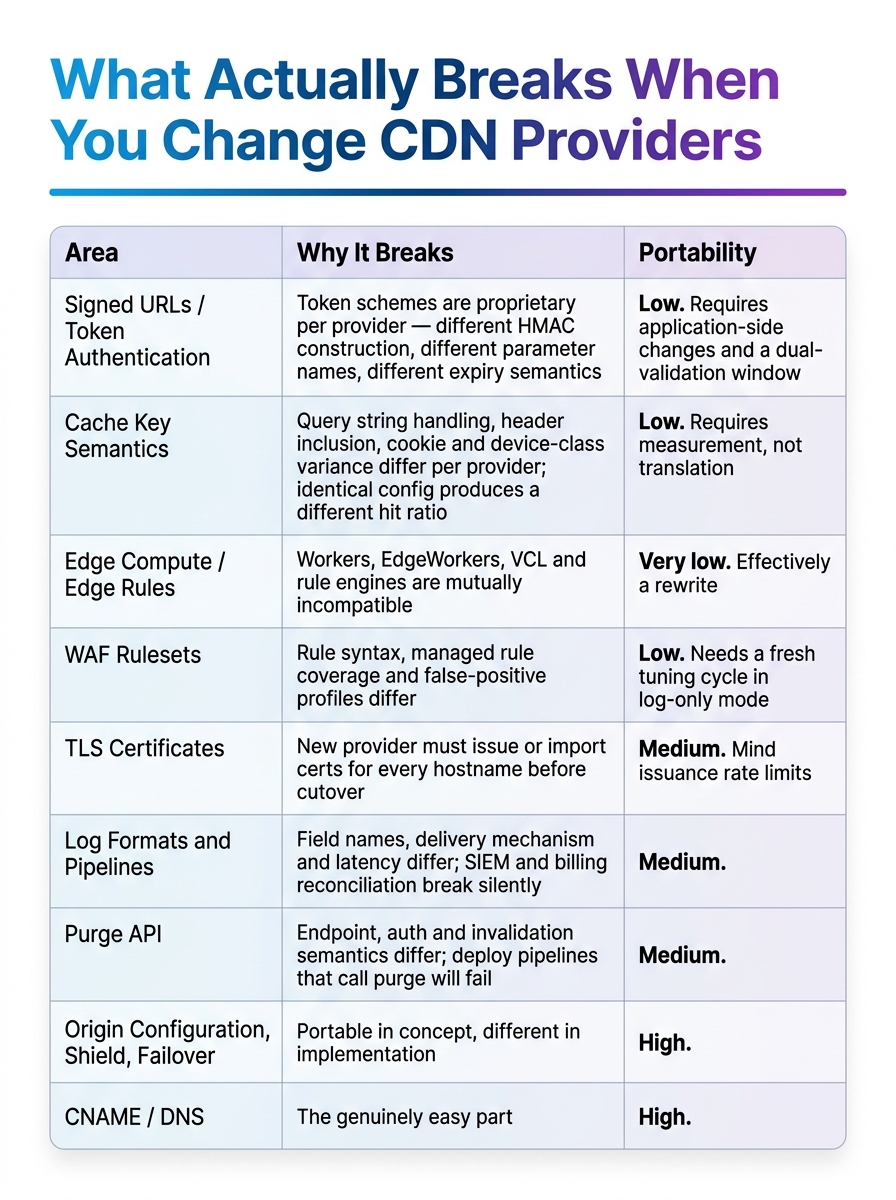
That mechanic has a second-order consequence most teams miss: because the discount is tied to allowlisted CDN IPs, changing CDN provider can silently change your origin egress rate. Factor it into any delivery migration before you cut over — see [what actually breaks in a CDN migration → /blog/cdn-shutdown-migration-playbook].
Flat-rate bandwidth is a different product, priced differently
Outside the hyperscalers, bandwidth is usually bundled or flat-rated rather than metered per gigabyte.
Sources: Better Stack (2026), DEV Community (2026), APICalculators (2026). Hetzner's US regions have been reported as including materially less transfer than EU regions — verify the allowance for your specific location before modeling, because that single line changes the arithmetic completely.
The gap is real: a media-heavy workload at 10 TB/month sits inside Hetzner's included allowance and costs roughly $40/month in DigitalOcean overage on top of the instance. At AWS list rates the same traffic is around $913.
Here is the part no bandwidth provider will put in a comparison table: a €1/TB provider and a $90/TB provider are not selling the same product. What you buy at the higher price is transit blend quality, peering density, burst headroom, and the ability to absorb an unannounced traffic spike without your network engineer's phone ringing. Cheap bandwidth is often a thinner blend with more single-homed paths, which shows up as p95 latency variance and packet loss on specific eyeball networks rather than as an outage. If you are serving an API to a global audience, model the transit blend, not just the price. If you are serving static assets through a CDN anyway, the origin's transit quality matters far less and the cheap bandwidth is close to free money.
This is the trade INXY prices for clients weekly: bundled or unmetered transfer on [dedicated and cloud servers → /hosting-solutions] where the transit blend is fit for the workload, rather than the cheapest per-terabyte number on the market.
Why the EU Data Act will not cut your monthly bill
Regulation (EU) 2023/2854 has applied since 12 September 2025. Article 29 phases out switching charges: until 12 January 2027 providers may charge only reduced fees limited to costs directly linked to the switch, and from that date they may impose no switching charges at all — a prohibition that expressly captures data egress charges levied for the purpose of switching (Pinsent Masons, 2025; Turing Law, 2025).
The three largest providers moved ahead of the deadline with free-exit programmes: Google announced one on 11 January 2024, AWS on 5 March 2024, and Microsoft on 13 March 2024 (UK Competition and Markets Authority, Appendix N).
Now the caveat that the compliance blog posts skip. The Data Act removes the penalty for leaving. It does not make the service cheaper while you stay. Two consequences follow:
- Multi-cloud egress is explicitly carved out. Charges remain permitted for egress conducted for in-parallel use of services, on the reasoning that multi-cloud deployment is ongoing data movement rather than a one-off switching operation (Pinsent Masons, 2025), with Article 34(2) allowing those costs to be passed through at cost. If your architecture runs continuously across two providers, the 2027 date does nothing for that line item.
- The cost will look for somewhere else to live. A prohibition on switching charges does not remove the commercial instinct behind it. Expect pressure to migrate into support tiers, minimum commitments, premium networking, and the categories the regulation leaves standing.
Free-exit programmes are also one-time and conditional on actually leaving. They are not a discount you can apply to a running workload.
How to audit your egress in one afternoon
- Pull 90 days of billing data grouped by usage type, not by service. On AWS, the usage types you want are DataTransfer-Out-Bytes, NatGateway-Bytes, and the regional DataTransfer-Regional-Bytes codes. Grouping by service hides the cumulative tier.
- Split internet egress from internal transfer. These have different fixes. Internet egress is a delivery-architecture problem; cross-AZ and NAT are a topology problem.
- Find your p95, not your average. Egress is spiky. A monthly average tells you what you paid; the p95 tells you what a flat-rate or 95th-percentile contract would actually cost. If p95 is more than roughly twice your mean, per-GB metering is punishing you for a traffic shape a committed-rate contract would absorb.
- Check what fraction is cacheable. Static assets, media segments, and installer binaries served directly from object storage are the cheapest thing to fix — putting a [CDN in front of the origin → /data-delivery] converts origin egress into cache-fill traffic, typically an order of magnitude less volume.
- Inventory public IPv4 addresses and idle NAT gateways. Both bill whether or not they carry traffic.
- Model the same volume against one flat-rate and one zero-egress provider. Not to migrate — to know your negotiating position. A concrete alternative quote is the only leverage that reliably moves an enterprise discount.
If step 6 is the one you keep postponing, that is the part we do for free: send the usage-type export and we will model it across the networks we broker. [Request an infrastructure audit → /book-a-demo].
What breaks in production
Assuming the CDN eliminates egress. It relocates it. You still pay origin-to-edge cache fill, and if your cache hit ratio is poor — short TTLs, high cardinality cache keys, query strings not normalized — the cache-fill bill can approach what you were paying before. Measure cache hit ratio by content type before crediting the CDN with savings.
Modeling in decimal terabytes when the provider bills in binary. A 10 TB estimate is 10,000 GB or 10,240 GB depending on the convention, a 2.4% error that compounds at petabyte scale. Pin the convention before presenting the number to finance.
Ignoring request pricing on zero-egress storage. R2's Class A operations run $4.50 per million (LeanOps, 2026). A workload with millions of small writes can hand back a meaningful share of the egress savings.
Treating a free-exit programme as a migration budget. It covers the data transfer out. It does not cover dual-running two environments, the engineering time, or the period where you pay both providers.
Optimizing egress and creating a latency problem. Google Cloud Standard Tier is cheaper than Premium because traffic exits closer to the source and traverses the public internet for longer. That is the correct trade for backups and batch export. It is the wrong trade for an interactive API where p99 is a product requirement.
The decision framework
Four questions, in order:
- Is the traffic cacheable? If yes, the fix is delivery architecture, not a provider switch. Put a CDN in front and measure cache hit ratio.
- Is the traffic spiky? If p95 is far above the mean, look at committed-rate or flat-rate bandwidth. Per-GB metering charges you for the peak shape.
- Is it egress-dominant relative to storage? If bandwidth outweighs storage on your bill, [S3-compatible object storage → /s3-compatible-object-storage-for-business] changes the economics outright, because the egress line stops scaling with delivery volume. If your data mostly sits untouched, the reverse applies — you would be paying a storage premium for an egress benefit you do not use.
- Is p99 latency a product requirement? If yes, the cheapest transit blend is not the answer, and the comparison table above stops being the whole picture.
Most teams that come to INXY with an egress problem have a delivery-architecture problem and a contract problem, in that order. We broker bandwidth, CDN capacity and object storage across multiple vendors on a single invoice, which means we can model your actual traffic against several networks and tell you when the answer is "stay where you are and renegotiate" — a conclusion no single provider is structurally able to reach.
The concrete next step is not a sales call. Send your last 90 days of billing data grouped by usage type and we will return a modeled comparison across the providers that fit your traffic shape, including the case for staying put. [Request an infrastructure audit → /book-a-demo]. If you would rather look at the components first: [CDN, streaming and data delivery → /data-delivery], [dedicated and cloud servers → /hosting-solutions], or [S3-compatible object storage → /s3-compatible-object-storage-for-business].
FAQ
How much does cloud egress cost per GB in 2026? Entry rates for internet egress are $0.09/GB on AWS, $0.087/GB on Azure, and $0.12/GB on Google Cloud Premium Tier. Cloudflare R2 charges nothing for egress. All three hyperscalers tier downward with volume, and AWS and Azure converge at $0.07/GB above 50 TB and $0.05/GB above 150 TB per month.
Does the EU Data Act ban egress fees? From 12 January 2027, providers serving EU customers may not charge switching fees, and that ban expressly covers egress charges incurred to switch providers. It does not ban egress charges for ongoing use, and it explicitly permits charging for data egress in in-parallel multi-cloud deployments. Your running bill is unaffected.
Why did my Google Cloud networking bill increase in May 2026? Google raised list prices for CDN Interconnect, Direct Peering, and Carrier Peering effective 1 May 2026, roughly doubling North American peering egress from $0.04 to $0.08 per GiB. Standard internet egress was unchanged. The increase applies automatically to traffic bound for allowlisted CDN IP ranges, with no configuration change required.
Is Cloudflare R2 actually free for egress? R2 charges $0.00/GB for egress at any volume, with no fair-use cap. You pay for storage at $0.015/GB-month and for API operations, with Class A operations at $4.50 per million. For write-heavy or request-heavy workloads, operations cost can offset a meaningful share of the egress saving.
Should I use a CDN to reduce egress fees? A CDN converts origin egress into cache-fill traffic, which is typically an order of magnitude smaller. The saving depends entirely on cache hit ratio. Short TTLs, unnormalized query strings, and personalized responses all push traffic back to origin, and a poorly configured CDN can produce cache-fill costs close to your original egress bill.
What is the cheapest bandwidth for high-traffic workloads? Flat-rate and bundled-transfer providers price far below hyperscaler metering — roughly €1/TB in overage versus around $90/TB at AWS entry rates. The trade is transit blend quality and burst headroom. For CDN-fronted static content the cheap option is usually correct; for latency-sensitive traffic served directly from origin, it usually is not.
Written by Igor Kirichenko, Senior Infrastructure Solutions Architect at INXY Hosting. INXY is a vendor-agnostic infrastructure marketplace and consultancy, brokering bandwidth, CDN, object storage and dedicated capacity across multiple providers on a single invoice.
Published 29 August 2026. All rates are list prices verified against provider documentation at time of publication. Cloud pricing changes frequently; this page is reviewed quarterly and rates should be confirmed against the provider before budgeting.